Multiple Choice
Identify the
choice that best completes the statement or answers the question.
|
|
|
1.
|
An SRS of 80 high school teachers was selected and
the mean number of years of teaching service was  = 12 years, with a standard deviation
of s = 3 years. Assume the distribution of the time the population of all high school teachers
have taught is approximately normal with mean m. Do the
observed data represent evidence that m has changed from its value
of 10 years from 15 years ago? To determine this, we test the hypotheses H0:
m = 10, Ha: m
¹ 10 using the one-sample t test. = 12 years, with a standard deviation
of s = 3 years. Assume the distribution of the time the population of all high school teachers
have taught is approximately normal with mean m. Do the
observed data represent evidence that m has changed from its value
of 10 years from 15 years ago? To determine this, we test the hypotheses H0:
m = 10, Ha: m
¹ 10 using the one-sample t test.
The appropriate
degrees of freedom for this test are
|
|
|
2.
|
The one sample t statistic from a sample of
n = 15 observations for the one-sided test of
H0: m = 8, Ha: m > 8 has the value t = 2.19. Based on this information, which of the
following would be true?
A) | 0.05 < P-value <
0.10. | B) | 0.025 < P-value <
0.05. | C) | 0.02 < P-value <
0.025. | D) | 0.01 < P-value <
0.02. | E) | 0.005 <
P-value < 0.01. |
|
|
|
3.
|
The one sample t statistic from a sample of
n = 23 observations for the two-sided test of
H0: m = 10, Ha: m ¹ 10 has the value t = 1.93. Based on this information, which of the
following would be true?
A) | We would reject the null hypothesis at a = 0.10 but not at a =
0.05. | B) | We would reject the null hypothesis at a = 0.10 and at a =
0.05. | C) | We would reject the null hypothesis at a = 0.05 but not at a =
0.01. | D) | We would reject the null hypothesis at a = 0.05 and at a =
0.01. | E) | We would not reject the null hypothesis in this test at
any reasonable a
level. |
|
|
|
4.
|
Which of the following conditions are not
necessary for the use of the one-proportion z procedures?
A) |  | B) |  | C) | the data must be a random sample from the population of
interest | D) | The population size is at least 10 times greater than
the size of the sample | E) | All of these
conditions are necessary |
|
|
|
5.
|
Quality control specialists are testing the filling
machine at a water bottling plant to determine how accurately it hits the target amount of 500
ml. They fill 6 bottles at random times throughout the day and find the amounts of bottled
water in the sample are 502, 500, 502, 498, 499 and 496. Assuming that the filling amounts are
normally distributed with mean m, they test whether the filling
machine is properly calibrated by testing the hypotheses
H0: m = 500 vs Ha: m ¹ 500. Based on the data, the value of the one-sample t
statistic is
A) | 0.52 | B) | -0.52 | C) | 0.21 | D) | -0.21 | E) | .32 |
|
|
|
6.
|
You are thinking of using a t-procedure to
test hypotheses about the mean of a population using a significance level of 0.05. You know the
population distribution is normal with  and and  . Which of the following statements is
correct? . Which of the following statements is
correct?
A) | You should not use the t-procedure here since the
populatiuon mean is less than 30. | B) | You may use the
t-procedure here provided you have a sample size that is 30 or
greater. | C) | You may use the t-procedure here with any sample
size. | D) | You should not use the t-procedure here because
this is a problem of proportions. | E) | You may use the
t-procedure here provided there are no outliers or strong skewness in the sample
data. |
|
|
|
7.
|
An educational researcher is collecting data for a
study on the job market for graduating business majors in 2012. One variable of interest is the
percentage of business grads who were able to find employment in their field within 6 months of
obtaining their degree. The researcher hypothesizes in advance of the study that less than 40% of
business grads will be able to find jobs within 6 months of graduation. To answer this question, one
should use
A) | one-proportion z test | B) | one-sample t test | C) | one-sample z
test | D) | one-proportion t test | E) | none of the above |
|
|
|
8.
|
In a test of H o: p = 0.7 against H a: p ¹ 0.7, a random sample of 200 yields a test statistic of  . The
P-value of the test is approximately equal to A) | 0.08 | B) | 0.16 | C) | 0.24 | D) | 0.32 | E) | 0.40 |
|
|
|
9.
|
A random sample survey of 175 skiers at a large European resort found that 28%
of the those surveyed had taken a ski vacation outside their own country within the past year. The
observed value of the test statistic for testing the null hypothesis  versus the alternative
hypothesis  is A) |  | B) | 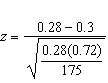 | C) | 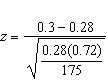 | D) |  | E) | None of the
above |
|
|
|
10.
|
A survey of 150 randomly selected football fans
found that 60 favor stricter drug testing in the sport. Is this convincing evidence that fewer than
half of all football fans favor stricter drug testing?
A) | Yes, because 60 is less than half of
150 | B) | Yes, by conducting a significance test, you can see that
these sample results provide convincing eveidence that less than half of all football fans favor
stricter drug testing. | C) | No, by conducting
a significance test, you can see that these sample results do not provide convincing eveidence that
more than half of all alumni favor abolishing the dress code. | D) | No, because the survey only used a sample of football
fans. | E) | Yes, because the sample was found using a randomization
procedure. |
|